

Navigent

MARS LabNanyang Technological University

A Geometry-Grounded Agentic Framework for Vision Language Navigation

Abstract

Vision-and-Language Navigation (VLN) with general-purpose multimodal large language models (MLLMs) offers a flexible alternative to task-specific navigation policies, while reliable long-horizon execution remains challenging. Agents must track navigation progress, detect discrepancies between commanded and actual motion, and recognize when movement has passed relevant landmarks or entrances.

We present Navigent, an agentic VLN framework built around a frozen MLLM and a Geometry-Grounded Execution Critic (GEC). GEC performs two complementary checks: action-to-motion consistency, which evaluates measured displacement against commanded movement, and motion-to-landmark consistency, which tracks agent-selected visual anchors and entrance candidates in world coordinates. Detected discrepancies interrupt the remaining action sequence and trigger reobservation, local adjustment, or node-based recovery. Historical visual memory supports progress tracking across extended routes. An offline self-improvement procedure further analyzes successful and failed training trajectories to refine navigation prompts and GEC logic while keeping model weights fixed.

On the R2R-CE validation-unseen split (1,839 episodes) and RxR-CE validation-unseen split (3,669 episodes), Navigent achieves 84.0%/86.0% SR and 72.9%/69.1% SPL, respectively, demonstrating the value of geometry-grounded execution verification for reliable agentic navigation.

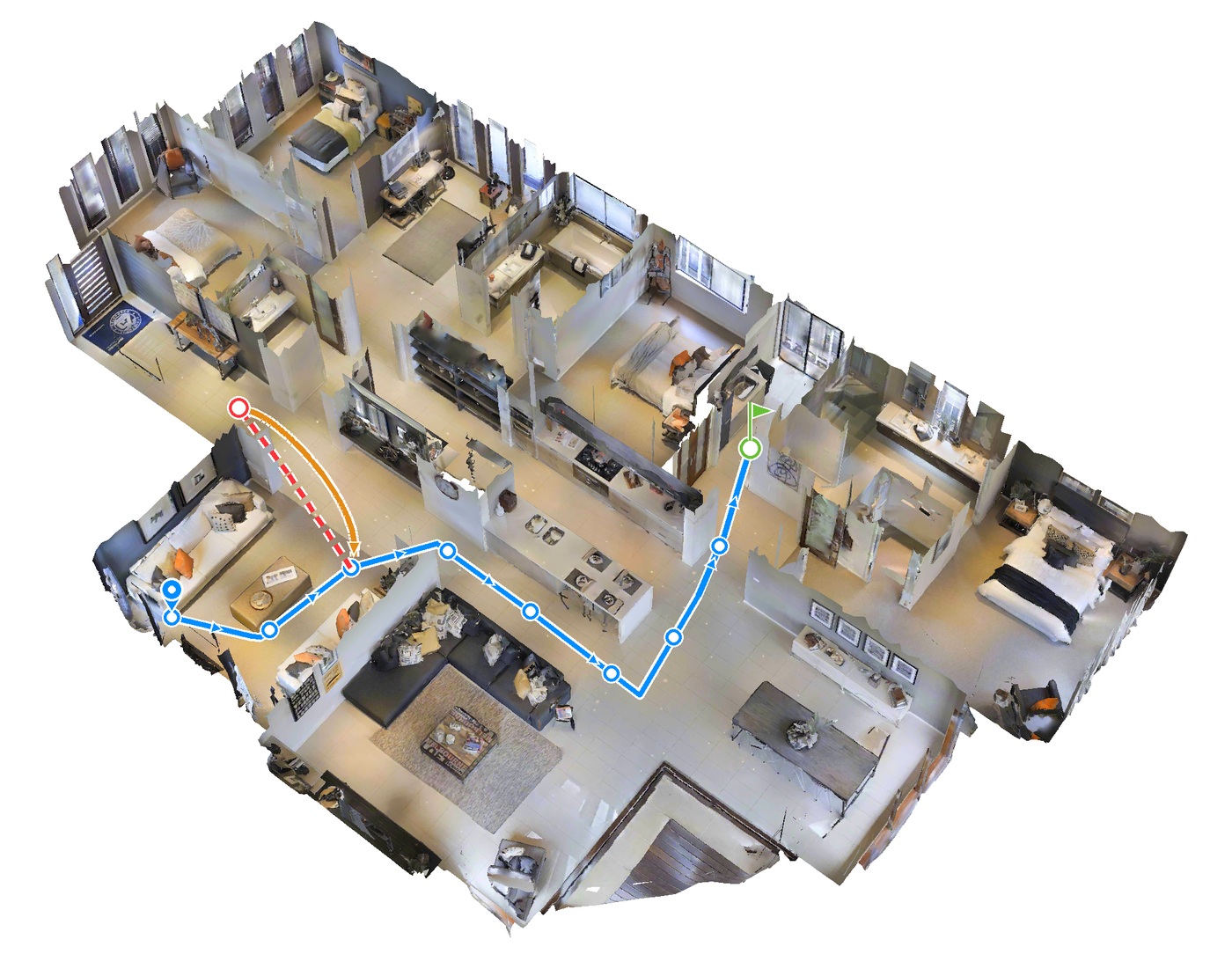
Navigent route showing a correct path, a wrong turn, and recovery
A Navigent route with a correct path, a wrong turn, and recovery.
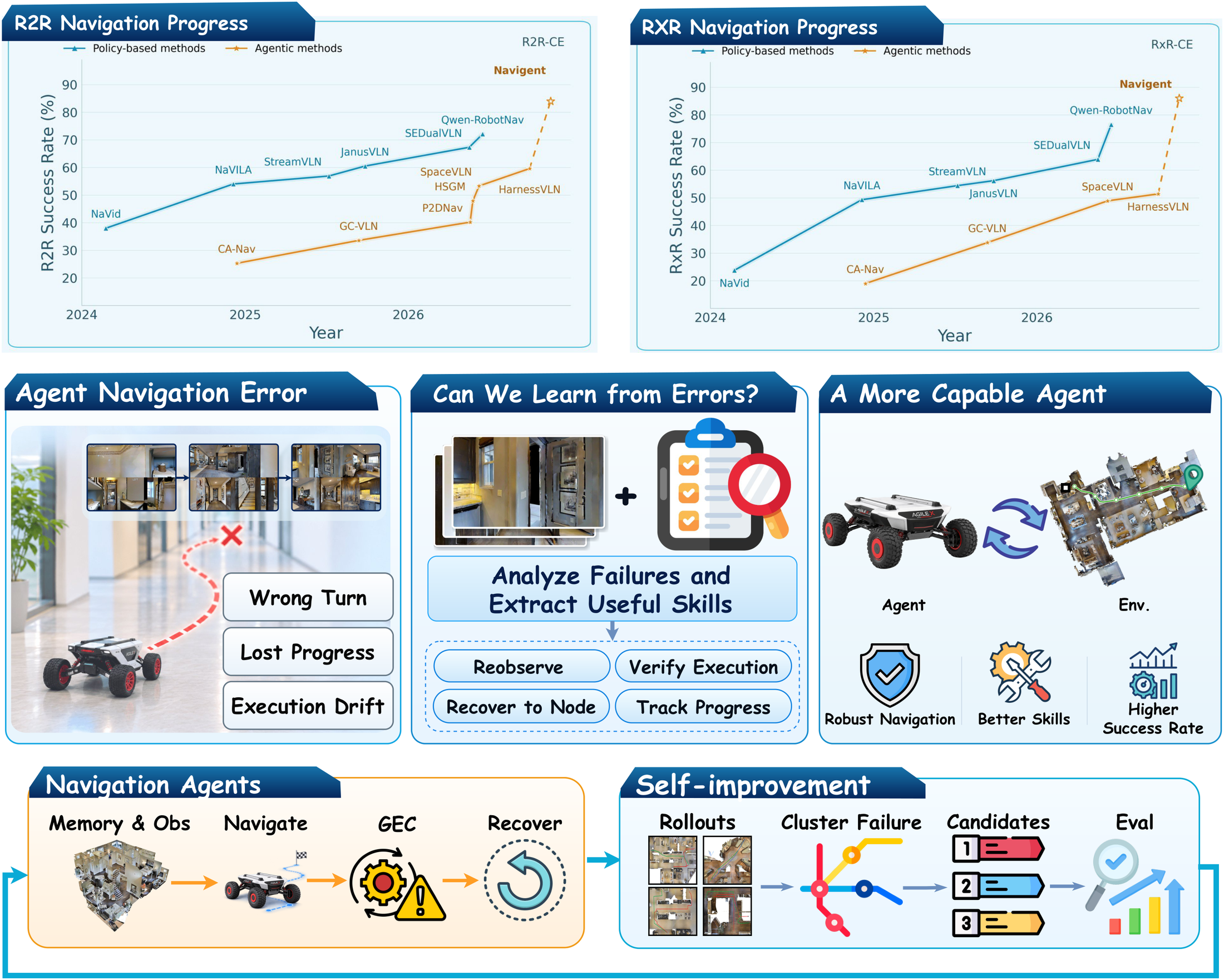
Navigent motivation: navigation progress on R2R-CE and RxR-CE, then geometric execution checks and offline self-improvement
Figure 1.Navigent combines geometric execution checks with self-improvement. The plots compare navigation performance on R2R-CE and RxR-CE.

Method

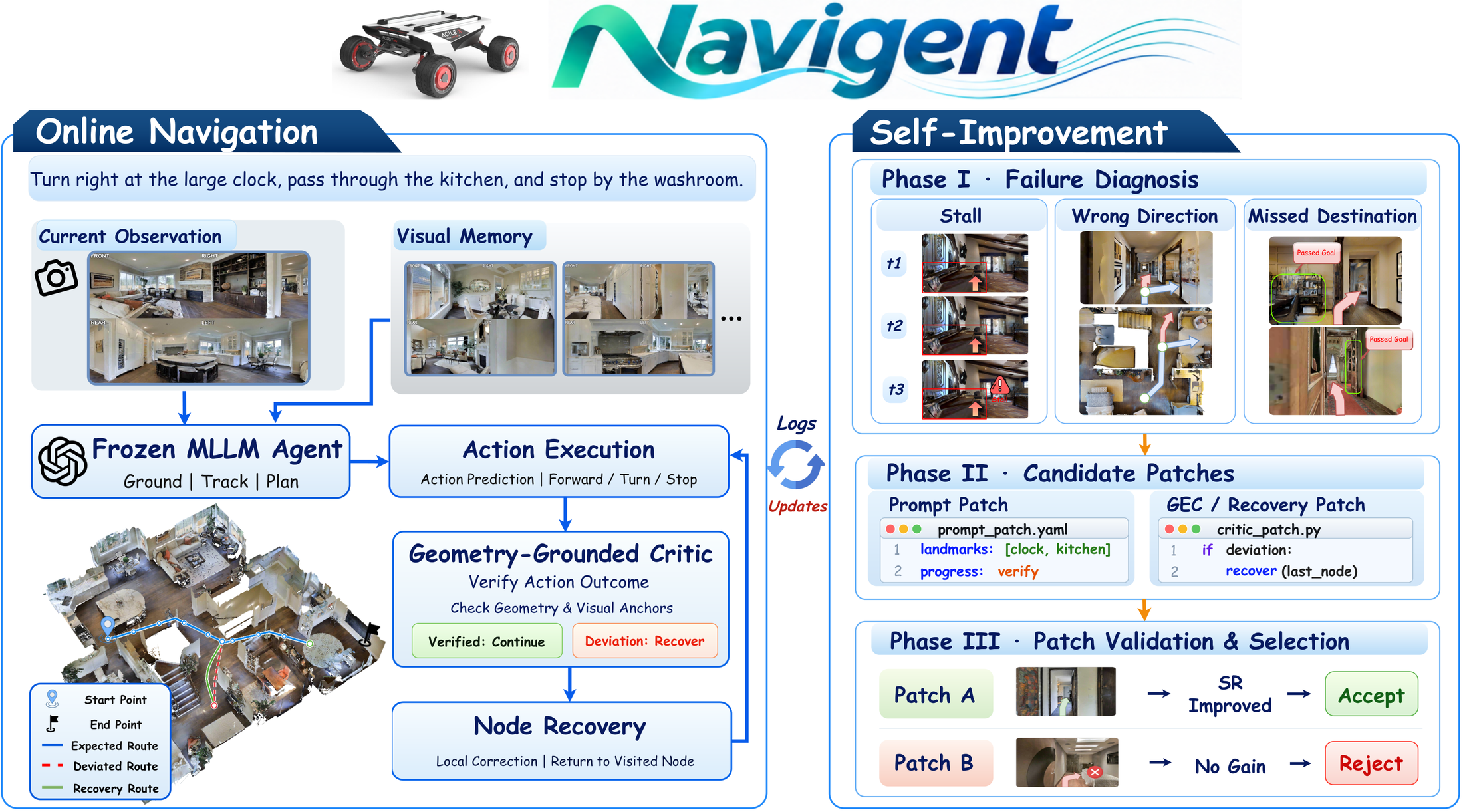
Given a natural-language route instruction, Navigent uses successive visual observations to choose movement commands and decide when to stop at the described destination. The method combines uniform historical visual memory with a Geometry-Grounded Execution Critic (GEC) and node recovery, while self-improvement refines navigation prompts and GEC logic.

Visual memory supplies the current observation and up to eight images sampled across the executed route. The agent predicts a short action sequence, while GEC monitors measured execution and local visual anchors. A detected discrepancy interrupts the remaining sequence; the agent then reobserves and chooses a local adjustment or a return to a visited node. The selected version remains fixed during navigation evaluation, while observation memory and execution state continue to update.

Navigent framework showing online navigation and offline self-improvement
Figure 2.Online navigation and offline self-improvement.

Navigation Context and Execution

Following a route requires relating the current scene to previously encountered landmarks and branches. Navigent retains a chronological observation archive and uniformly samples it at each decision, allowing the agent to inspect earlier route segments within a fixed budget of newly attached images. The current observation is outside the eight-frame history budget. The instruction enters the first decision and later decisions continue the same episode conversation. Navigation state records the starting pose, trajectory, visited nodes, traversed connections, return-path lengths, relative return bearings, heading, previous primitive counts, and blocked status.
Geometry-Grounded Execution Critic and Node Recovery

The agent predicts discrete forward and turning commands, or STOP, and executes a bounded prefix before obtaining a new observation. Each forward primitive is checked against its measured displacement. A depth precheck estimates near-field clearance before forward execution; measured motion checks detect insufficient forward progress, persistently small displacement, negative forward progress, or excessive lateral displacement. Local visual anchors track the distance and bearing of selected targets in world coordinates, while entrance candidates support entrance monitoring. When a discrepancy is detected, the remaining primitives are discarded and the agent receives a fresh observation, updated self-pose, primitive counts, and blocked status to choose a local adjustment or return to a visited node.

Self-Improvement

Completed training episodes are used for offline self-improvement of navigation prompts and GEC implementation while the MLLM weights remain fixed. Successful and failed trajectories provide observations, model responses, executed primitives, and measured motion for failure diagnosis. Three candidate patches are proposed from the same parent version, evaluated on the fixed training set, and compared by repairs minus regressions. Only a candidate with positive net gain is carried forward; otherwise the current version is retained. The selected prompt and GEC implementation are then fixed for navigation evaluation.

Video

Simulation

R2R / RxR

Hallway to the mirror

R2R-CE / episode 1807

Pass between the couch and counter, follow the hallway, and stop by the mirror.

Stairs to the bedroom

R2R-CE / episode 1122

Climb the stairs, turn left, and wait at the bedroom doorway.

Across the room to the bar

R2R-CE / episode 8

Cross the room and wait at the far end of the bar.

Kitchen to the dining room

RxR-CE / episode 8858

Pass between counters, go through the arch, and stop by the dining table.

Arched hallway to the bathroom

RxR-CE / episode 9142

Pass the kitchen island, take the arch beside the stairs, and enter the bathroom.

Red carpet to the doorway

RxR-CE / episode 8717

Follow the red carpet past the chairs and stop at the open doorway.

Real world

SCOUT MINI deployment · Two indoor tasks and two outdoor tasks

Black to blue cylinders

Indoor / cylinder sequence

Approach the black cylinder, then continue to the blue cylinder.

Cylinder round trip

Indoor / cylinder shuttle

Navigate between the black and blue cylinders and return to the starting area.

Second white pillar

Outdoor / pillar task

Follow the route and stop at the second white pillar.

Water dispenser to green bin

Outdoor / trash-bin task

Navigate from the water dispenser to the green trash bin.

Recovery

The wrong doorway

Returned to node 2, chose another door, and stopped 0.11 m from the goal.

Fireplace approach

Returned to node 3 and approached the fireplace from the other side.

Gallery junction

Returned to node 2 and took the hallway toward the wall-mounted guitar.

Gym entrance

Returned near the dining area before entering the exercise space.

Bathroom beyond the piano

Recovered from the dresser and piano area, then reached the bathroom.

Results

84.0%
R2R-CE success rate
86.0%
RxR-CE success rate
90.0%
Real-world success rate

Benchmark performance

Navigent reaches 84.0% SR on R2R-CE and 86.0% SR on RxR-CE. The complete metrics are retained in the table.

MethodR2R-CERxR-CE
NE ↓OSR ↑SR ↑SPL ↑NE ↓SR ↑SPL ↑nDTW ↑
HNR4.4267.061.051.05.5056.346.763.5
NaVid5.4749.137.435.98.4123.821.2—
NaVILA5.2262.554.049.06.7749.344.058.8
Uni-NaVid5.5853.547.042.76.2448.740.9—
StreamVLN4.9063.656.450.25.6554.445.463.7
JanusVLN4.7865.260.556.86.0656.247.562.1
NavFoM4.6172.161.755.34.7464.456.265.8
CorrectNav4.2467.565.162.34.0969.363.375.2
OmniNav3.7474.669.566.13.7773.662.0—
AwareVLN4.0273.565.455.13.9567.656.165.7
InstructNav6.90—31.024.0————
NavGPT-CE8.4026.916.310.2————
CA-Nav7.5848.025.310.810.3719.06.013.5
GC-VLN7.3041.833.616.38.8033.813.8—
AO-Planner6.9538.325.516.6————
HSGM5.4258.747.932.8————
GTA4.9556.248.841.8————
HarnessVLN4.0870.759.643.66.5051.438.155.6
AgentVLN3.8873.567.264.73.9269.561.374.6
Navigent2.2286.184.072.91.9286.069.179.7

Real-world deployment

We evaluate Navigent on an AgileX SCOUT MINI mobile robot with an Intel RealSense D456 depth camera. Each of two indoor tasks and four outdoor tasks is attempted five times. A trial succeeds only when the robot executes STOP within 1 m of the designated target.

The indoor evaluation tests approaching a black cylinder followed by a blue cylinder, and shuttling between the two cylinders. The outdoor evaluation tests a gray chair, a green trash bin, the second white pillar after a corridor turn, and the route from the water dispenser to the green bin. Navigent completes 27 of 30 trials, for 90.0% SR.

TaskSuccessesSR
Indoor
Black, then blue cylinder4/580.0%
Black-blue cylinder shuttle5/5100.0%
Outdoor
Approach the gray chair5/5100.0%
Approach the green trash bin4/580.0%
Stop at the second pillar4/580.0%
Water dispenser, then green bin5/5100.0%
Overall27/3090.0%

Analysis

The ablations separate the contributions of route memory, offline refinement, execution verification, and conversational state. The plots show the main trends; the tables retain the complete reported metrics.

Historical-frame selection

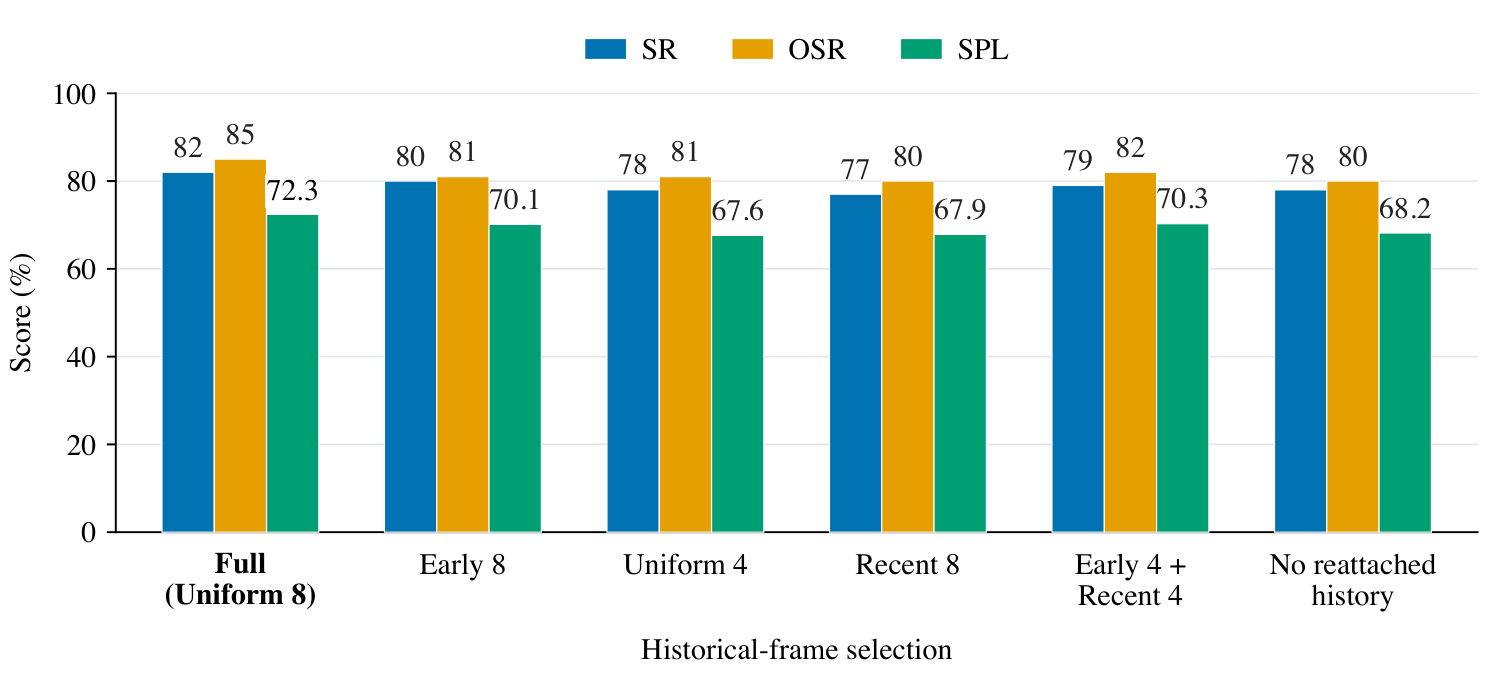
Uniformly sampled history gives the strongest route context. All six strategies retain the current observation, episode conversation, and execution critic. No reattached history retains earlier dialogue, while Early 4 + Recent 4 retains unique frames in temporal order.

Historical-frame selection ablation comparing SR, OSR, and SPL
Figure 3.Uniform 8 achieves the highest SR, OSR, and SPL. Compared with No reattached history, it raises SR from 78% to 82% and SPL from 68.2% to 72.3%; other eight-frame strategies reach 77–80% SR, while Uniform 4 reaches 78% SR and 67.6% SPL.
History policySROSRSPL
Full (Uniform 8)828572.3
Early 8808170.1
Uniform 4788167.6
Recent 8778067.9
Early 4 + Recent 4798270.3
No reattached history788068.2

Offline self-improvement

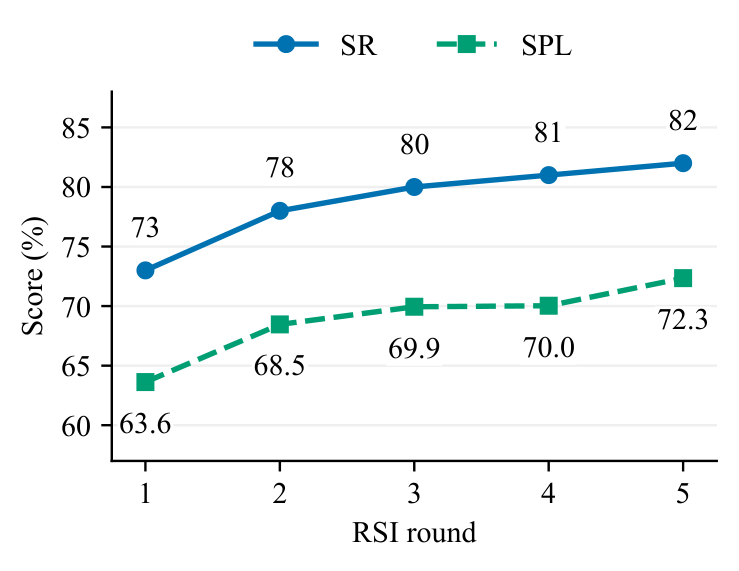
Each round adds a cumulative navigation capability. The five configurations are evaluated on Open-Nav100 with frozen MLLM weights. Prompt refinement adds explicit checks for landmark order, spatial relations, and visual progress; later rounds add execution evidence.

Self-improvement ablation showing SR and SPL across five rounds
Figure 4.The basic configuration uses measured pose changes to detect stalled forward motion. Depth warnings check obstacles before execution; visual anchors track target distance and bearing; route review compares the current route with the instruction and recorded observations. SR rises from 73% to 82%, with OSR reaching 85% after visual anchors and the final route review reaching 72.3% SPL.
Round / updateSRSPLNEOSR
1: Basic configuration7363.63.1078
2: + Prompt refinement7868.53.2980
3: + Depth warning8069.93.0581
4: + Visual anchor8170.02.4785
5: + Route review (Full)8272.33.5485

What each state signal contributes

Each ablation is shown as a complete row. The controlled removals use the same Open-Nav100 evaluation setup and retain the other navigation inputs unless stated otherwise.

Geometry-Grounded Execution Critic

The critic links commanded actions to measured motion and target geometry. With the prompt fixed, adding the critic and route review improves SR by 5 points and SPL by 2.8 points, while reducing NE from 4.09 m to 3.54 m. This comparison isolates the execution-monitoring contribution on Open-Nav100.

GECSRSPLNEOSR
Off7769.54.0980
Full8272.33.5485

Self-Pose and Visited-Node Inputs

Pose and node records provide state for ordinary decisions and recovery. The executor still retains geometric feedback in every row. Removing either input reduces SR from 82% to 79%; removing both lowers it to 76%. Without pose, NE improves despite lower SR and SPL, so lower navigation error alone does not imply better task completion.

State inputsSRSPLNEOSR
Full8272.33.5485
w/o Pose and Nodes7670.63.3283
w/o Nodes7969.03.0182
w/o Pose7969.12.7283

Conversation Continuity

Continuing the episode conversation preserves route context. Single-turn evaluation keeps the instruction and sampled images but resets the dialogue at every decision. SR falls from 82% to 69%, SPL from 72.3% to 60.1%, OSR from 85% to 71%, and NE rises from 3.54 m to 4.47 m. Visual history alone therefore does not recover the benefit of a continuing conversation.

ConversationSRSPLNEOSR
Full8272.33.5485
Single-turn6960.14.4771

BibTeX

@misc{zhou-navigent,
  title  = {{Navigent}: A Geometry-Grounded Agentic Framework
            for Vision Language Navigation},
  author = {Zhou, Xinyu and Cai, Weiren and Chen, Yitong and
            Yuan, Shenghai and Mu, Zihang and Ma, Boyu and
            Dong, Jiahua and Lu, Yanshuo and Bai, Jiaqi and Yang, Jianfei},
}